
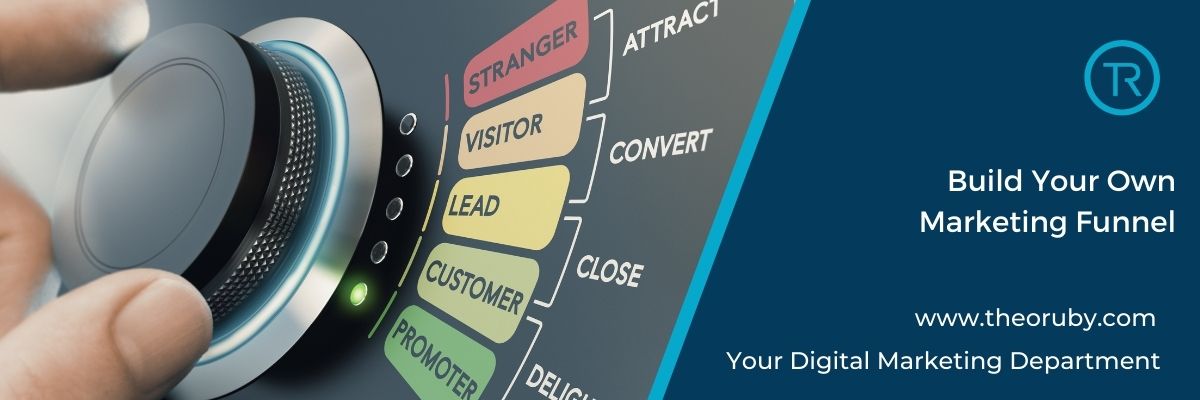
A Marketing Funnel is a theoretical model that shows a customers’ journey towards the purchase of a good or service. The funnel illustrates 5 stages including: Plan, Reach, Act, Convert, and Engage. A Marketing Funnel is important to help you prioritise, organise, and implement your marketing strategy and creates a clear path to making sure you, as a business owner, understands the customers’ buying journey from start to finish and future buying habits.
By understanding the customers journey, you can gain an insight into your target audiences’ behaviour and what has encouraged them to initially make a purchase. In turn, you can adapt your marketing strategies when needed and ensure that your products are suitable for them going into the future, enabling a sustained growth. The mnemonic ‘RACE’ can be used to implement an effective Marketing Funnel.
What does a marketing funnel include?
Before you start building your own marketing funnel there is an initial stage of ‘plan’ which looks at creating an overall strategy and setting business objectives. This is covered in more detail in our workshop but you can book a free planning session here.
Examples of Reach include weekly announcements on Facebook, curated graphics and polls to test engagement.
KPI’s include audience volume, audience quantity, and audience value and cost.
Example or Act include creating a PDF download, building subscribers for a newsletter campaign, or promoting a free trial of a product or service.
Key measures include leads, time on site, and subscribers, likes and share across your social media platforms.
Examples generating sales or subscriptions for a product. Make sure to start measuring from the moment the first sale comes in!
Key measures include sales (both online and offline), revenue, and conversion and order value.
Send out surveys to satisfied customers and generate google reviews and reccomendations.
Key measures include Repeat purchase, satisfaction and loyalty, and advocacy.
What does success look like?
Measures of success are known as KPIs (Key Performance Indicators) and have clear links with the Marketing Funnel as it helps to determine how organic and paid marketing techniques are performing against quantifiable goals. KPIs can vary from business to business, as every business has a different end goal and measures of success.
Notable KPIs throughout the Marketing Funnel may include: return on investment (ROI), cost-per-click (CPC), cost-per-acquisition (CPA), cost-per-lead (CPL).
By setting up a Marketing Funnel it will allow you to understand the customer journey and why they should purchase from your business rather than a competitor, boosting your brand loyalty and helping your business to grow. Whilst implementing a Marketing Funnel, it’s important to set KPIs to stay on track and be able to meet your overall business objectives and goals.
How do I start building my marketing funnel?
To start building your own funnel following the process demonstrated above and join our Build Your own Marketing Funnel” workshop which takes place on the 2nd Friday of every month on Zoom. We will cover all building blocks of the funnel and provide templates for you to follow along at your own pace as well as a 12-week support group for any follow up questions. Book your space here
Most funnels boil down to five stages. Awareness: someone discovers you exist, through search, social, or word of mouth. Interest: they look closer, reading your blog or following you. Decision: they compare you against alternatives. Action: they enquire or buy. Retention: they come back and refer others.
You do not need clever software for this. A clear landing page, a simple email list, and a follow-up habit cover most of it for a small business.
Find the leak. Plenty of traffic but no enquiries means the website is the problem. Enquiries that never convert means the follow-up is the problem. No traffic at all means awareness is the problem, and everything downstream is irrelevant until that is fixed.
Google Analytics shows the journey from arrival to enquiry, and your email marketing platform shows opens and clicks. Two numbers a month is enough to spot the leak.
The path a stranger takes to become a customer. It narrows at every step, which is why it is drawn as a funnel: many people hear of you, fewer look closer, and fewer still buy.
You already have one, whether you designed it or not. Mapping it just shows you where people fall out, and that is usually one fix rather than ten.
At minimum: a website with one clear call to action per page, a free analytics account, and an email tool. Add more only when a stage is genuinely limited by the tool, not the habit.